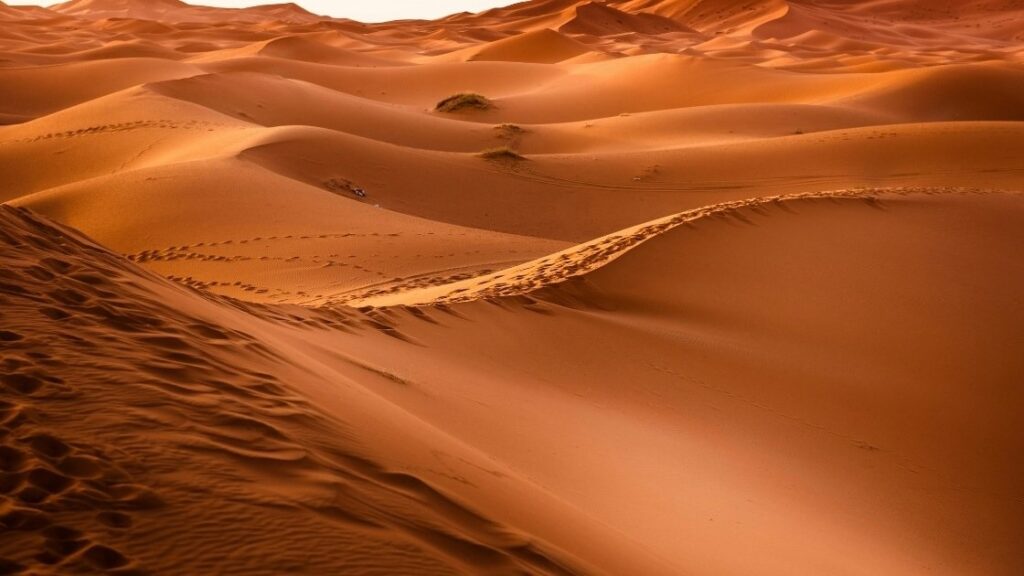
When most people hear the word “desert,” they picture endless golden desert sands rippling under a blazing sun. That mental image only scratches the surface. Sandy arid landscapes are geological archives each grain records millions of years of weathering, wind transport, and climate change. They support specialized ecosystems, drive global dust cycles, and sit at the center of a resource crisis that few people talk about.
According to the U.S. Geological Survey (USGS), sand covers only about 20 percent of Earth’s total arid surface USGS. The remaining three-quarters consist of clay, exposed bedrock, ice, or mineral-poor soils called aridisols, as noted by EBSCO’s Earth Sciences research EBSCO. So what creates all that loose, granular material, and why should you care? This guide covers everything from grain-level geology to the billion-dollar desertification crisis so you never need another page on this topic.
Table of Contents
How Do Desert Sands Form?
Sand in arid regions begins its life as solid rock. Over thousands to millions of years, physical and chemical weathering processes break stone into progressively smaller fragments until individual grains measure between 0.0625 mm and 2 mm in diameter.
Extreme temperature swings between day and night stress rock surfaces, causing fractures and splits that deepen over time, as explained by ScienceABC ScienceABC. Wind then lifts and carries the smaller particles sometimes across hundreds of miles depositing them wherever terrain features slow the airflow, as described by OneGeology Onegeology.
Having walked across parts of the Thar Desert near the Pakistan–India border, I can confirm that fine windblown grit infiltrates everything clothing, gear, even sealed water bottles within minutes. That personal observation underscores just how aggressively aeolian (wind-driven) processes move sand in real-world conditions.
The process works like a natural sorting machine. Heavy fragments stay near the parent rock. Medium grains bounce along the surface in a movement geologists call saltation. The finest silt and dust particles suspend in the air, sometimes forming massive haboobs (dust storms) visible from space.
The Three Stages of Sand Formation
| Stage | Process | Timescale |
| Weathering | Temperature shifts, chemical reactions, and root growth fracture bedrock | Thousands to millions of years |
| Transport | Wind (aeolian) and occasional flash floods carry fragments downslope | Continuous |
| Deposition | Grains accumulate behind obstacles or in low-lying basins, forming dunes and sand sheets | Ongoing dunes can shift meters per year |
What Types of Sand Dunes Exist in Arid Regions?
Dune morphology depends on three variables: wind speed, wind direction consistency, and available sand supply. Geologists recognize five primary dune forms, each with a distinct footprint.
| Dune Type | Shape | Wind Pattern | Typical Height | Example Location |
| Barchan | Crescent, horns point downwind | Single prevailing direction | 1–30 m | Sahara, Atacama |
| Transverse | Long, wave-like ridges | Strong single direction | Up to 25 m | Namib Sand Sea |
| Linear (Seif) | Narrow, elongated ridges | Bi-directional, seasonal | Up to 100 m | Simpson Desert, Australia |
| Star | Radiating arms from central peak | Multi-directional, variable | Up to 150 m | Grand Erg Oriental, Algeria |
| Parabolic (Blowout) | U-shaped, horns point upwind | Single direction with vegetation anchor | 3–30 m | Great Sand Dunes, Colorado |
Inside every growing dune, layers of sand create a geological signature called cross-bedding a record of how wind repeatedly pushed grains up the windward slope and let them cascade down the steep leeward face, as described in the Geosciences LibreTexts geology textbook Geosciences LibreTexts.
Why Is Desert Sand a Different Color in Every Region?
Sand color is a direct fingerprint of its mineral source. The hue tells geologists where the grains came from and how long they have been exposed to weathering.
As Sandatlas explains, while quartz the dominant mineral in most dune fields is naturally clear or milky-white, the overall color of sand is often determined by iron oxide coatings or other mineral films on grain surfaces Sandatlas.
| Sand Color | Primary Mineral or Cause | Famous Location |
| White | Pure quartz or gypsum | White Sands, New Mexico |
| Pale yellow | Quartz mixed with feldspar | Central Sahara |
| Orange-red | Iron oxide (hematite) coatings on quartz | Simpson Desert, Australia |
| Black | Volcanic basalt fragments (magnetite, ilmenite) | Sandur plains, Iceland |
| Pink | Crushed coral and foraminifera shells | Bermuda (coastal, not desert) |
According to ScienceInsights, the redder the sand, the longer it has been exposed to atmospheric oxidation making color a rough indicator of geological age ScienceInsights.
Desert Sand vs Beach Sand: What Is the Difference?
This is one of the most searched questions related to arid geology and the answer has enormous economic consequences.
| Feature | Desert Sand | Beach / River Sand |
| Grain shape | Highly rounded and polished by wind | Angular and rough from water tumbling |
| Surface texture | Smooth, frosted | Jagged, irregular |
| Binding ability | Poor grains slip past each other | Strong edges interlock in concrete |
| Primary transport agent | Wind (aeolian) | Water (fluvial / marine) |
| Use in construction | Unsuitable for concrete | Industry standard |
The International Monetary Fund’s Finance & Development journal, referencing UNEP data, explains that wind-rounded grains are too smooth and uniform to bind with cement paste IMF. This is why countries like the UAE surrounded by vast sandy expanses import construction-grade aggregate from abroad.
Where Are the World’s Largest Sand Seas?
Geologists use the Arabic-origin term erg to describe vast expanses of windblown sand stretching across hundreds or thousands of square kilometers.
- Rub’ al Khali (Empty Quarter) Spanning roughly 650,000 km² across Saudi Arabia, Oman, Yemen, and the UAE, it is the largest continuous sand body on the planet, with dunes exceeding 250 meters in height.
- Grand Erg Oriental Located in the northeastern Sahara across Algeria and Tunisia, covering approximately 192,000 km².
- Great Sand Sea Straddling western Egypt and eastern Libya, extending over roughly 72,000 km².
- Namib Sand Sea A UNESCO World Heritage site along Namibia’s Atlantic coast, famous for towering red-orange dunes sculpted by fog-laden winds.
- Great Sand Dunes, Colorado Part of a U.S. national park at the base of the Sangre de Cristo Mountains, as referenced by Geosciences LibreTexts Geosciences LibreTexts.
National Geographic Education notes that dunes cover only about 10 percent of all arid terrain worldwide National Geographic Education, which makes these concentrated ergs even more geologically significant.
What Lies Beneath the Sand?
Lift the sandy surface of any erg and you will find the same bedrock and compacted sediment that defines the broader regional geology.
ScienceABC reports that approximately 80 percent of the world’s arid zones are not sand-covered they reveal bare earth, cracking clay, and exposed stone shaped by millennia of erosion ScienceABC. Where dunes do accumulate, they often sit atop ancient alluvial deposits washed down from nearby mountain ranges. The rolling contours of a dune field may even mirror buried hills that existed long before sand buried them.
Beneath the top layer of many sandy surfaces,ScienceInsights explains that a biological soil crust composed of cyanobacteria, lichens, mosses, and fungi stabilizes grains, fixes atmospheric nitrogen, and retains precious moistureScienceInsights. A single footprint can destroy a biocrust that took decades to develop, which is why staying on marked trails matters.
How Does Wildlife Survive on Sandy Arid Terrain?
Life on arid, shifting sand demands extraordinary biological creativity. Far from being lifeless wastelands, dune ecosystems host specialized organisms that have evolved remarkable survival strategies.
National Geographic reports that camels can go weeks without water, and their eyelashes and nostrils act as physical barriers against blowing grit National Geographic. Meanwhile, the Namibian desert beetle harvests fog directly from the air for hydration National Geographic a survival trick so elegant that engineers now study it for biomimetic water-collection technology.
Key Animal Adaptations
According to Wikipedia’s Desert Ecology entry (citing peer-reviewed sources), most small mammals in these habitats are nocturnal, retreating into underground burrows where temperatures remain far more stable than the scorching surface Wikipedia. Species like the oryx and antelope ground squirrel have evolved elevated resting body temperatures, which reduces the moisture loss that would occur from active cooling mechanisms like sweating Wikipedia.
Key Plant Adaptations
Britannica notes that soil beneath individual shrubs is several times more fertile than exposed ground between plants, because roots pull nutrients upward and shed them as surface litter Encyclopedia Britannica. Cacti store water inside thickened stems, while deep-rooted species like mesquite can reach underground aquifers several meters below.
The Global Sand Mining Crisis
Sand is the second-most exploited natural resource on Earth after water and the world is running low on the kind that matters.
According to the World Economic Forum, citing UNEP data, sand mining has tripled in the past two decades, with global demand reaching approximately 50 billion tonnes annually by 2019 World Economic Forum. A 2022 UNEP report titled Sand and Sustainability found that extraction rates are rising about 6 percent per year a pace the agency called unsustainable, as covered by UNEP’s reporting UNEP.
Why Desert Sand Cannot Solve the Shortage
As covered in the comparison table above, wind-polished grains lack the angular edges needed to bind in concrete. This means the enormous sand reserves of the Sahara, Rub’ al Khali, and other vast ergs are largely useless for construction. The construction industry depends on river, coastal, and marine sand finite sources under severe ecological stress.
What Is Being Done?
UNEP has outlined 10 strategic recommendations, including creating legal frameworks for extraction, developing a circular economy for building materials, and restoring ecosystems damaged by mining UNEP. Recycling demolition waste and exploring ore-sand (a by-product of mineral processing) are two promising alternatives gaining traction.
The Desertification Emergency: Why Sandy Landscapes Are Expanding
Desertification is the degradation of productive land in dry regions until it can no longer sustain vegetation or agriculture. It threatens billions of people and costs the global economy staggering sums every year.
A landmark 2024 report from the United Nations Convention to Combat Desertification (UNCCD) found that roughly 77.6 percent of Earth’s land experienced drier conditions between 1991 and 2020 compared to the preceding three decades United Nations. During that same period, global drylands expanded by approximately 4.3 million square kilometers an area nearly a third larger than India United Nations.
The UNCCD’s 2025 factsheet estimates that drought, land degradation, and desertification cost the global economy roughly $878 billion every year UNCCD.
| Desertification Driver | How It Expands Sandy Terrain |
| Overgrazing | Strips root systems that anchor topsoil |
| Deforestation | Removes canopy cover, exposing bare soil to wind |
| Poor irrigation practices | Depletes aquifers and salinizes productive fields |
| Rising global temperatures | Reduces rainfall, accelerates evaporation |
| Urbanization | Compacts surrounding soil, disrupts natural drainage |
The UNCCD estimates that approximately 500 million people now live in areas that have experienced desertification since the 1980s UNCCD.
Restoration Success Stories
Targeted interventions can reverse the damage. China’s Great Green Wall project has already planted billions of trees since 1978, and research suggests it has reduced the frequency and intensity of dust storms, as reported by UNEP UNEP. At UNCCD COP16 in Riyadh (December 2024), the Riyadh Action Agenda aimed to mobilize commitments to conserve and restore 1.5 billion hectares of land globally by 2030, as reported by the World Resources Institute World Resources Institute.
How to Experience Desert Sands Responsibly
Visiting dune landscapes is a bucket-list experience. Here are practical tips drawn from both travel expertise and conservation science:
Top Dune Destinations Worth Visiting
| Destination | Country | Best Season | Highlight |
| Erg Chebbi | Morocco | October–April | Towering Saharan dunes, camel treks, Berber culture |
| Namib-Naukluft Park | Namibia | May–October | Red dunes of Sossusvlei, Deadvlei salt pan |
| Wadi Rum | Jordan | March–May, Sept–Nov | Sandstone valleys, Bedouin camps, stargazing |
| Great Sand Dunes NP | USA (Colorado) | Late May–September | Tallest dunes in North America, Sangre de Cristo backdrop |
| Thar Desert | India/Pakistan | November–February | Living desert culture, Jaisalmer Fort, migratory birds |
Responsible Travel Guidelines
- Stay on marked trails to protect fragile biological soil crusts that take decades to regenerate.
- Carry significantly more water than you think you need arid air pulls moisture from your body far faster than humid climates.
- Time your visit for early morning or late afternoon when temperatures are manageable and golden-hour light rewards photographers.
- Leave absolutely no trace pack out all waste, including biodegradable items that decompose extremely slowly in dry conditions.
- Respect wildlife corridors many arid-region animals are crepuscular (active at dawn and dusk), so drive slowly and keep noise low.
Cultural and Historical Significance of Sandy Deserts
Sandy arid landscapes are not just geological features they have shaped civilizations, trade routes, and spiritual traditions for millennia.
The Silk Road traversed the Taklamakan Desert, connecting Chinese, Persian, and Roman empires through one of history’s most perilous trade corridors. Bedouin tribes have navigated the Arabian sands for centuries, developing navigation, clothing, and water-conservation practices perfectly adapted to extreme heat. The Tuareg people of the Sahara, often called “the blue people” for their indigo-dyed garments, built entire trading networks across some of Earth’s harshest terrain.
Ancient Saharan rock art some dating back 10,000 years depicts cattle, wildlife, and human activity in regions that are now completely barren. Britannica notes that these depictions suggest the present extent of desert in the Old World is significantly greater than it would be without human impact Encyclopedia Britannica.
Understanding this cultural depth is essential for any traveler or researcher approaching sandy landscapes with respect and context.
Conclusion
Desert sands are far more than a scenic backdrop. They are geological records, ecological habitats, climate regulators, and cultural touchstones all compressed into grains smaller than a pinhead. Here are the key takeaways:
- Sand covers only ~20% of arid land most deserts are rocky, gravelly, or clay-covered.
- Grain color reveals geological history white means pure quartz, red signals iron oxide, black points to volcanic origins.
- Wind-rounded desert grains are useless for concrete creating a global resource paradox where sand-rich nations still import aggregate.
- Desertification is accelerating drylands expanded by 4.3 million km² in three decades, affecting 500 million people directly.
- Restoration works tree planting and sustainable land management are producing measurable results in China, the Sahel, and beyond.
Whether you are a geology student, a sustainability advocate, or a traveler planning your first dune expedition, understanding these landscapes is no longer optional it is essential.
Found this guide useful? Share it with someone who cares about our planet’s future, and drop your questions or personal desert experiences in the comments below.
Q1: What are desert sands made of?
Most grains in arid dune fields are primarily quartz one of the hardest common minerals on Earth, rating 7 on the Mohs scale. In specific locations, dunes may consist of gypsum (White Sands, New Mexico), volcanic basalt fragments (Iceland), or even coral-derived calcium carbonate, depending entirely on the local source rock.
Q2: Why can’t desert sand be used to make concrete?
Wind erosion rounds and polishes individual grains over thousands of years, creating surfaces too smooth to interlock when mixed with cement. Construction aggregate requires rough, angular particles typically sourced from riverbeds, marine floors, or crushed rock quarries.
Q3: How fast can sand dunes move?
Migration speed varies with dune size, wind strength, and sand supply. Smaller barchan dunes in the Sahara can shift between 10 and 30 meters per year, while massive star dunes may remain nearly stationary for centuries due to their multi-directional wind inputs.
Q4: Is desertification reversible?
Yes, with targeted intervention. Rotational grazing, reforestation, and improved irrigation can rehabilitate degraded land over time. China’s Great Green Wall which has planted billions of trees since 1978 and Africa’s pan-continental reforestation initiative are two large-scale examples currently demonstrating measurable progress.
Q5: Do all deserts have sand dunes?
No. USGS data confirms that sand covers only about 20 percent of global arid land. The majority of desert surfaces consist of exposed bedrock (hamada), gravel plains (reg or desert pavement), salt flats (playas), or compacted clay.
Q6: What is the largest sand desert on Earth?
The Rub’ al Khali (Empty Quarter) stretches across roughly 650,000 square kilometers of the Arabian Peninsula. It is the largest continuous body of sand in the world, with individual dunes reaching heights exceeding 250 meters.