Key Takeaways
- Factories installed 542,000 industrial robots in 2024, double the number from ten years ago (Source: IFR World Robotics 2025 Report).
- Global operational stock reached 4.66 million units, growing 9% year over year.
- Cobots are the fastest-growing segment at roughly 19% annual growth (Source: MarketsandMarkets).
- Amazon crossed one million warehouse robots in mid-2025.
- China accounts for 54% of all new installations worldwide.
What Is Industrial Robotics Technology?
Industrial robotics technology is the use of programmable, automated machines in manufacturing environments. These robots handle welding, painting, assembly, packaging, material handling, and quality inspection with speed and consistency that humans cannot sustain across long shifts.
The first industrial robot, Unimate, was installed at a General Motors plant in 1961 to lift hot metal parts from a die-casting machine. Since then, the field has changed completely. Modern industrial robots use sensors, machine vision, artificial intelligence, and cloud connectivity to perform tasks that were impossible a decade ago.
The International Federation of Robotics defines an industrial robot as an automatically controlled, reprogrammable, multipurpose manipulator programmable in three or more axes, following the ISO 8373 standard. What separates industrial robots from basic automation is flexibility a conveyor belt does one thing, but a robot can be reprogrammed for hundreds of different tasks.
How Industrial Robots Work
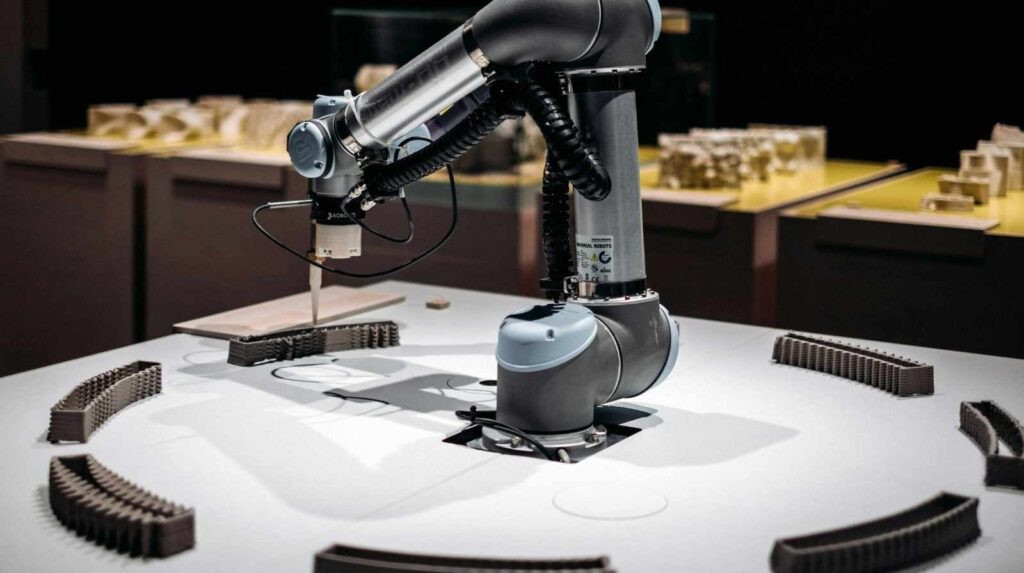
Every industrial robot has three core systems. The mechanical body includes the arm, joints, and base. A standard six-axis robot can rotate, extend, bend, and twist with precision down to 0.02 millimeters. The controller is the computer brain that sends signals to motors at each joint, making thousands of calculations per second. The end effector is the tool at the tip welding torches, grippers, suction cups, cameras, or spray nozzles depending on the task.
Programming has evolved from manually guiding the arm through motions using a teach pendant to offline 3D simulation software and AI systems where robots learn by watching human demonstrations.
Types of Industrial Robots
Articulated Robots are the most common. They have four to six rotary joints giving them human-arm-like motion. Used for welding, painting, and assembly. FANUC, ABB, KUKA, and Yaskawa are the biggest manufacturers.
SCARA Robots move fast horizontally with limited vertical motion. Ideal for pick-and-place and small-parts assembly in electronics factories.
Delta Robots hang from overhead frames with three lightweight arms. Extremely fast, used mainly for picking and sorting on moving conveyor lines in food and pharmaceutical production.
Cartesian Robots move in straight lines along X, Y, and Z axes. Simple, affordable, and precise popular for CNC machining and 3D printing.
Collaborative Robots (Cobots) work safely alongside humans without safety cages. Built-in sensors detect contact and stop immediately. Cost between $20,000 and $50,000, making them accessible to small businesses. Universal Robots, FANUC, and ABB lead the market.
Autonomous Mobile Robots (AMRs) navigate factory floors independently using sensors and AI. Amazon’s Proteus and Hercules are well-known examples.
| Type | Best For | Typical Cost |
| Articulated | Welding, painting, assembly | $50K–$400K |
| SCARA | Small parts, pick-and-place | $20K–$80K |
| Delta | High-speed sorting, packaging | $30K–$150K |
| Cartesian | CNC, large-area handling | $15K–$60K |
| Cobots | Human-robot collaboration | $20K–$50K |
| AMRs | Warehouse logistics | $25K–$100K |
Industrial Robotics by the Numbers
The IFR World Robotics 2025 Report provides the clearest picture. In 2024, 542,000 industrial robots were installed globally the second-highest annual count ever and more than double the figure from ten years ago. Installations have topped 500,000 units for four straight years.
Asia dominated with 74% of new deployments. Europe accounted for 16%, the Americas for 9%. China alone received 295,000 units 54% of the global total. Japan ranked second at 44,500 units, the United States third at 34,200, South Korea fourth at 30,600, and Germany fifth at 27,000. These five countries received 80% of all installations.
India set a record with 9,100 units installed, up 7%, driven by its automotive sector accounting for 45% of installations.
The IFR projects 575,000 installations in 2025 (6% growth) and expects the 700,000-unit mark to be surpassed by 2028.
Why Cobots Are Growing Fastest
Traditional industrial robots are powerful but dangerous, operating behind safety cages. Cobots changed this by using built-in force sensors that detect contact and stop immediately, following the ISO/TS 15066 safety standard.
According to MarketsandMarkets, the global cobot market is projected to grow from $1.42 billion in 2025 to $3.38 billion by 2030 at an 18.9% annual growth rate. The key driver is cost. Cobots cost $20,000 to $50,000 compared to $200,000 or more for traditional robots, and they pay for themselves within 12 to 30 months.
They are also far easier to program. Some models allow operators to set up new tasks in under an hour using drag-and-teach interfaces. This makes them practical for small and medium-sized manufacturers that lack dedicated robotics engineers.
Asia-Pacific leads cobot adoption with roughly 41% of the global market, according to MarketsandMarkets. Automotive and electronics together account for over 55% of cobot installations.
How AI Is Making Industrial Robots Smarter
Machine vision allows robots to identify defective products, locate randomly positioned parts, and read labels without human help. Reinforcement learning lets robots improve through simulated trial and error rather than requiring every motion to be manually programmed.
Predictive maintenance uses AI to monitor vibration, temperature, and motor data in real time. According to McKinsey research on smart manufacturing, this approach can cut machine downtime by 30% to 50% and extend equipment life by 20% to 40%.
Digital twins virtual replicas of physical robots and production lines let engineers test changes in simulation before making physical modifications. Amazon credited digital twin simulations for cutting development time of its Blue Jay robot to under one year, according to TechRepublic.
Real-World Case Studies
Amazon deployed its one millionth robot in mid-2025 at a fulfillment center in Japan. The fleet spans 300+ facilities with nine robot types including Hercules (lifts 1,250 pounds), Sparrow (picks individual items), and Sequoia (handles 30 million items daily). Amazon’s DeepFleet AI model improved fleet efficiency by 10%. Roughly 75% of Amazon’s global deliveries now involve robotic assistance, and output per worker jumped from 175 packages annually to 3,870 (Source: Wall Street Journal).
Foxconn announced humanoid robot deployment at its Houston plant for NVIDIA server manufacturing, targeting early 2026 production, according to industry reporting.
DHL expanded its fleet to 7,500 robots by partnering with Boston Dynamics for 1,000 additional collaborative units across its global logistics network.
Benefits of Industrial Robotics Technology
Robots work 24/7 without breaks, producing consistent quality across thousands of cycles. They take over dangerous jobs heavy lifting, toxic exposure, extreme heat reducing workplace injuries significantly. A single robotic welding cell can match the output of three to four skilled human welders. Long-term costs drop through reduced defects, less waste, and higher throughput. Cobots with their $20K–$50K price range reach payback in 12 months or less.
Risks and Challenges
A full robot cell can cost $100,000 to $500,000+, putting it out of reach for many small manufacturers. Job displacement remains an unresolved debate Amazon’s workers per facility dropped to the lowest in 16 years while robots passed one million. The manufacturing skills gap is real: Deloitte and the Manufacturing Institute project a U.S. shortage of up to 2.1 million skilled workers by 2030. Integration into existing factories is complex and expensive. Cybersecurity risks grow as robots connect to networks and cloud platforms.
The Future of Industrial Robotics (2026–2030)
Humanoid robots from Figure AI, Agility Robotics, Tesla, and Boston Dynamics will move from labs into factory pilots by 2027–2028. Robotics-as-a-Service (RaaS) will let manufacturers rent robots through subscriptions instead of buying outright. AI will push robots from assisted operation toward genuine autonomy. The IFR expects global installations to pass 700,000 units annually by 2028.
What is an industrial robot?
An automatically controlled, reprogrammable machine with three or more axes used in manufacturing for tasks like welding, assembly, and material handling.
How much does an industrial robot cost?
Traditional industrial robots cost $50,000 to $400,000+. Collaborative robots cost $20,000 to $50,000. Total cell cost including integration can reach $500,000.
What is the difference between a robot and a cobot?
Traditional robots operate behind safety barriers. Cobots have built-in sensors that detect human contact and stop immediately, allowing them to work alongside people safely.
Which country installs the most industrial robots?
China, with 295,000 units installed in 2024 54% of the global total, according to the IFR.
Will robots replace factory workers?
Robots are replacing specific tasks, not entire jobs in most cases. However, the workforce is shifting toward technical roles like robot programming, maintenance, and fleet management.
How long does it take for a robot to pay for itself?
Typically one to three years for traditional robots. Cobots can reach payback in 12 months or less depending on the application.
Pingback: Artificial intelligence in industrial automation: Integration of Computer Vision and AI for Quality Control in Automated Production Lines - Techyways